Wednesday, July 30, 2014

My Sojourn in the ER

I made a fool of myself in the ER recently.   Here's what happened:  I was at the gym, climbing onto the treadmill.   I punched in  the settings: weight-170, time - 45 minutes, speed - 2.8 mph, and elevation - 7.5%. Somehow the speed and elevation got interchanged and I suddenly found the treadmill going 7.5 mph, way faster than I can manage.I called out a feeble "help" and crashed hard onto my right side bounced around unceremoniously and eventually fell off the end.

My son, Thabie, and a trainer quickly came to my side and lifted me up.   My shoulder felt very sore, so Thabie drove me to the ER where I was quickly admitted.  The doctor ordered an X-ray which showed I had dislocated my shoulder.  The friendly and excellent doctor said he's heard of a new method of resetting the joint without anesthesia and hadn't tried it out yet.

He grabbed my shoulder firmly and started to push, whereupon I disgraced myself by screaming in pain and begging him to stop.  There followed a lot of movement (I think he must have given me a shot), much fussing around and then the triumphant announcement that my shoulder had been reset.  I was fitted with a sling and sent on my way with instructions to see my orthopedist soon.


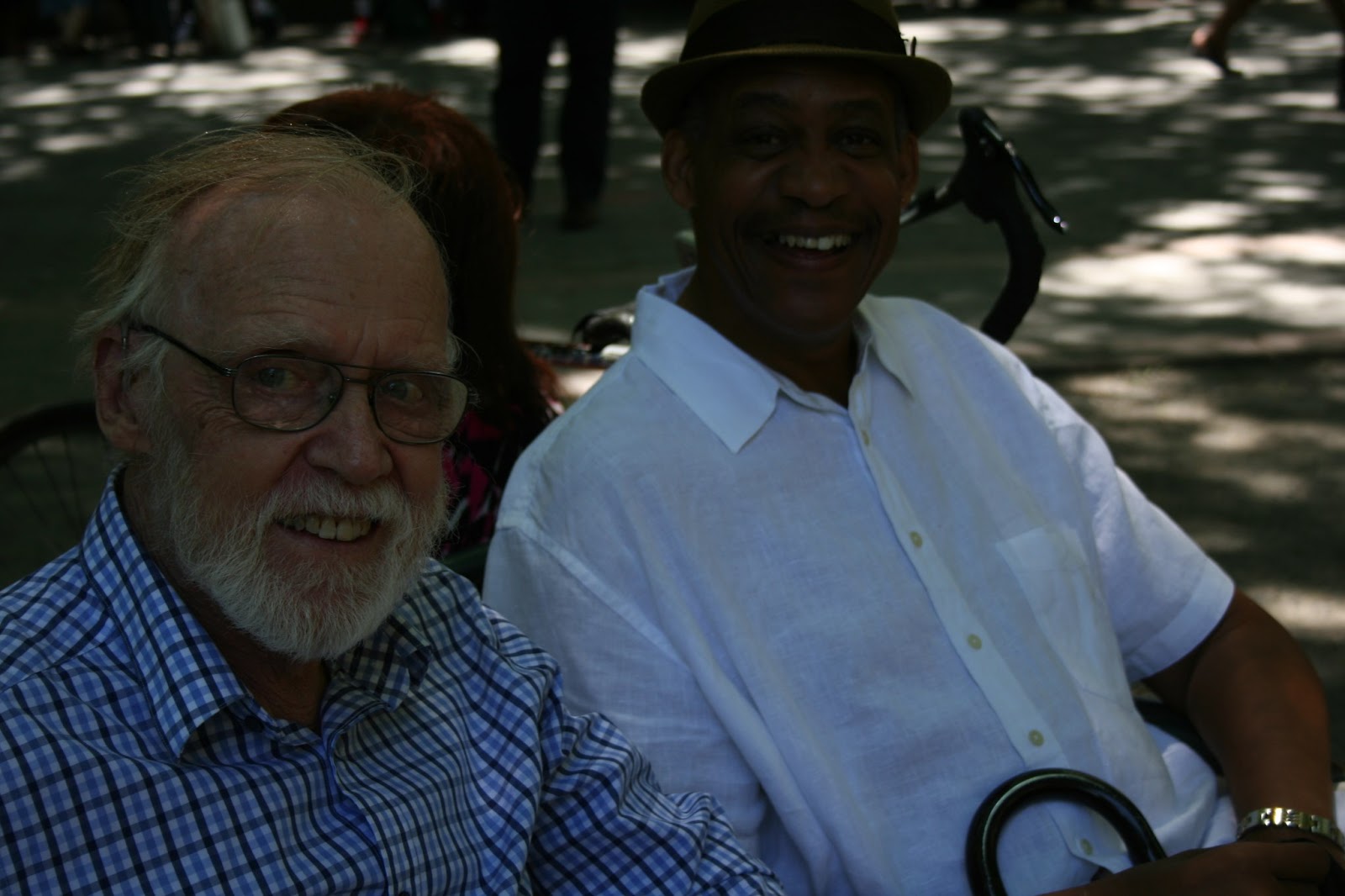
Here's what I looked like (appropriately sad) for three weeks.  A lot of things were suddenly difficult, eating, brushing my teeth, scratching my back, and so forth.   A visit to my orthopedist, three sessions of physical therapy, and  here's what I looked like:


My shoulder still hurts a lot but I'm on my way to recovery.   This experience is not recommended for someone my age or anyone else for that matter.

Saturday, July 19, 2014

Winter in the White Mountains - Take 2

Over the past few weeks, I had two very welcome surprises: first Fran Ansley, celebrating her 50th Putney School reunion contacted by phone and email, reminiscing fondly about camping trips we had taken.   I posted Fran's redirection  of our fall 63 trip up Mt. Adams.  Then a woman, who has lived in Australia for the past 45 years, and was a camper at the Putney Summer work Camp 60 years ago (when I was a counselor) managed to get in touch with  me via email.   She too reminisced about our camping trips.   I confess it's heartwarming to hear from these people with warm memories.

When I wrote "Winter in the White Mountains, an Adventure Story," I was recalling events v from 49 years  back.   In today;s post, here's Fran recalling the trip two weeks after the fact and in rich detail.

Winter Climb 1964 -- Mt. Adams and Crag Camp
Dear Mama and Daddy,
Bill Melvin is taking a group up Mt. Adams next weekend.  It looks like it will be a great trip.  Bob Mills will be co-leader.  (Normally Bill does not have a co-leader, but for a winter climb, this is really indispensable, and I think Bob will be a perfect person to have along.)
Last night we had a meeting in Bill’s apartment -- Boy, you wouldn’t believe the equipment.  Bear-paw (not tear-drop) snow shoes, long underwear, two pairs of wool pants, baggy ski pants, two sweaters, flannel shirt, hooded parka, gloves, mittens, four pairs of wool socks at least, boots, mukluks (canvas things that go over boots), one ski pole, face mask, down sleeping bag, etc., etc., etc.
Tomorrow another girl and I are going to make a fruit cake crammed with nuts, dates, fruit, raisins, honey, molasses, etc., for us to eat at night.  This is “survival bread,” as Bill says, “the  most amount of energy for the least amount of effort.”  On the trail, we’ll also have bags of GORP -- M&Ms, nuts, raisins, etc.  It scares but thrills me to think of all this. 
Yesterday, three of us girls who are going on the hike snowshoed up to Hepper Caldwell’s.  We went up a huge, steep hill that Bill told us to practice on for the trip.  It was fun and VERY cold and clear.  We were so clumsy with the huge things on our feet, slipping and sliding up the hill.  We wound up at Hepper’s and played with her four beautiful children until she got back from Brattleboro, then had tea and cinnamon toast like civilized people.  She drove us back down in time for dinner.  A very nice afternoon.
Today I’ve been racing around trying to dig up equipment.  I still need goggles and all kinds of things …

After the trip:
Well, where to start?  I want to tell you everything, but I just can’t.  The trip was a wonderful, wonderful thing, just as I knew it would be.
We left Friday after fourth period, the Greenbrier jammed with our packs, nine pairs of snow shoes, crampons, and food.  It takes about four hours to get to Bill Melvin’s cabin down below Crawford Notch.  It took us five, because the car was acting up.  Wonderful ride, everybody singing and teaching each other new rounds.  Bill telling off-color stories, etc. 
By the time we got there, of course, it was dark.  We piled out and walked the three quarters of a mile from the highway over the railroad tracks, into the woods, and on to the cabin.  Meanwhile one of the boys (the “tall one” I told you about before) was getting more and more excited.  He is such a good and funny person (and he must get so tired of being described as the tall guy).  He loves Bill’s cabin so much, and was the only one on the trip who’d been there before.  So as we were slogging along, he kept saying “Oh man, almost there.  Oh my god, I can’t stand it.”  We found, unbelievably, it was as great as he had said.  Here is a diagram of the floor plan …
We crammed in and started a fire in the fireplace and in the wood stove -- everyone ravenous (about 9:30 by now) --  Bill began making trips for water with whoever wanted to help.  I went with him once, and it was quite an expedition.  You walk about a quarter of a mile down to a brook.  Even in winter there’s liquid water there, because of the 75-foot cascade that tumbles down and keeps it from freezing solid.  You walk out on the ice to the hole that the rushing water makes, and throw a bucket on a rope into the water -- Bill said this was the first year he hasn’t fallen in.
There were steaks and vegetable soup and fruit cocktail for supper.  Everyone began to really relax and form an easy group.  We got the rolling, hysterical giggles about something inane, and finally all piled into bed.  The girls got the bunks (four bunks fold down from the wall on chains), and the boys got the floor.  Four hours later, at 4:30, we were waked up by Bill.  Time to get started.  We had breakfast, got dressed, and headed back to the car.  It was an hour’s drive from there to the place where we started climbing. 
Bill went into the people’s house who live at the base of the trail and registered us.  We all strapped crampons onto our packs, put on our snowshoes, and started off.  The first two miles were easy climbing … hard because of the steadiness of the gradual ascent, but really, as Bill said, “just a stroll through the woods.”  We took turns breaking trail -- the boys sticking it out for long stretches, the girls lasting fewer steps, but we worked at it too.  It was a wonderful feeling to be first in line, tracking the untouched snow, but it was terribly hard on the legs.  When you’d had enough, you dropped to the back of the line where it was easy going.  (When you are in the back of the line, eight people have been ahead of you and packed out the trail.)
Anyway, after about four hours, we reached a junction, stopped and had lunch, and then went on.  It was only about a mile to the camp from there, but that mile was straight up.  It took us three hours just to do that one mile. 
I had quite a hard time because my snowshoes didn't fit right.  To go up hill, you have to flip the snowshoe up into a horizontal position, and dig the toe of it into the snow.  The snowshoe needs to be horizontal, or you just slide backward on it.  (See diagram.)  Well there were times when I really didn't think I’d make it, because the toe of my mukluk-covered boot wouldn't stick in the hole right (perhaps because they were too big, and kind of floppy out there on the toe), so it was very hard to flip up the snowshoe and keep it aligned right.  Hard to explain, but it was very wearing, let me put it that way. Anyway, we finally did get to Crag Camp.
It is an incredible place.  Bunks, porch, sofas in front of a fireplace, a snug woodshed, stove, sink and an actual real live PUMP ORGAN.  It is also about 20 feet from a precipice that drops 1500 feet straight down.  Funny rickety rustic furniture, Bach chorale books, two bedrooms.  When we came in, everything inside was sifted over with fine snow.  It had come down the chimney, seeped under the door, blown in the windows, etc.  On the sofa there were tiny, tiny mouse tracks all in the snow.  So there was snow dusting to do.
But first we put on some snow in a pot to melt, and then we started for the summit right away while we still had daylight.  Because we were so high up, there were fewer trees, and the snow was not so deep due to getting blown about by the wind.  So we shed our snowshoes (hallelujah) and put on our crampons, which are spiky things that punch into the crust and help you keep your footing.  SO much nicer than snowshoes!   With the change of footwear, and shedding of packs, you felt light as a feather, and nimble too.  It was bliss.  As soon as we got above timberline, we put on face masks …  But as I told you on the phone, we had to give up before we even reached the col, because of the clouds.  The decision was that it wasn’t safe, and also wouldn’t be particularly rewarding if we were totally socked in.
So we hurtled back down to Crag Camp (practically running down -- it took us a third of the time it took to go up), had supper, sang, got back rubs from Bill, and collapsed into bed.
The first thing I heard next morning was Bill’s mellifluous voice telling us it was 25 degrees below zero.  Brother, was it ever hard to get out of my nice warm arctic sleeping bag.
Breakfast was really funny, with everyone trying to thaw out their boots, socks shirts, gloves, etc.  Socks had frozen hard in the shape of whatever they were draped over.
And we DID get to the summit that next day.  The very top is something I simply cannot express to you.  It was as if you had been dissolved into the elements and ceased to exist.  The wind was so strong (110 mph the filling station man said that night when we told him where we had been that morning) you couldn’t think, you couldn't see, you couldn't hear, you could only hang on for dear life.  It if hadn’t been for the crampons we would have been blown away.  I’m sure this was the stretch during which several of us got a bit of frost bite -- and G., with his long legs that have a tendency to be too long for any reasonable pant-leg, got more than a bit.
I want you all to SEE it … up near the top is like fairyland.  Little tiny trees completely covered in frozen-over snow.  Sometimes you step through the crust and see that you have been walking over the tops of little trees all along.
Anyway, down we came, following our flagged ski poles back.  Also red dye marks that Bob Mills, bless his heart, made on the snow as we went up.  We picked up our packs at the camp, switched (groan) back to snowshoes, and started down. 
“Bahoomyhoomy” is the word for what we did next.  One of the boys on the trip coined it his freshman year, and it means simply sitting down on your snowshoes and sliding.  Bill starts off, and everyone follows, careening and rolling and whooping -- like a toboggan ride -- back down that steep section of the trail.  We hit the junction soon (couldn’t believe what a short time it had been), and then stood up once more and hiked the rest of the way back down to the trailhead.  Supper at a Howard Johnson’s with everyone laughing at our decrepit state, and the boys ordering huge mounds of food.
Now I’m practically recovered.  The frostbite on my chin itches a little, and my feet are still swollen, but that’s all.  I had a sore throat today, but I slept, and it’s going away.  I must go now and get ready for supper.  I love you all.  Please know how much I thank you for letting me have experiences like this one …


Saturday, June 21, 2014

Mt. Adams, Take 2 by Fran

A few days ago I received a  most welcome phone call from someone I last talked to 50 years ago.   It was Fran Ansley who had been a student at Putney School, class of 1964.  She and her classmates were getting ready for their 50th reunion and she recalled the winter ascent of Mt. Adams (see my post of July 8, 1913, "Winter in the White Mountains") as well as a trip I took with Putney students in Fall, 1963.   Fran is a terrific writer who regularly wrote detailed descriptions to her family just after the trips were completed.   With Fran's permission I am posting her description of that fall trip.

Jun 19 at 10:00 AM
Long Fall 1963 -- Presidential Range -- Mt. Jefferson and Mt. Adams
Dear Family,
The Long Fall trip was really wonderful.  We left on Friday morning in a truck with one other tripful of people, who we dropped off on the way.  It was a good truck ride … lots of singing and joke telling, and not too cold.  We had lunch on the way.  People were crammed in.  It seemed like everyone must have had four feet.  Boots were jabbing everywhere.
Finally (that is, seven hours later), we got to Bowman, New Hampshire, where our trail started.  It is in the northern end of the Presidential Range.  We all piled out, put on our packs and started off with a chill in our bones because there was snow on the ridge.
The climb was pretty stiff, but I never reached that horrible point of not believing I could go on.  It was lovely to hike this time of year, because the path (which frustratingly consumes so much of one’s attention) is starred with leaves -- curly red and yellow. 
By sunset, we were just below timberline and reached our shelter -- three-sided plus a fireplace -- “The Perch” -- It is literally perched on the side of a ravine on the shoulders of Jefferson and Adams.
We had “gloosh,” that Bill Melvin specialty.  And we SANG.  Bill is the best tenor in madrigals, has perfect pitch and a really fine voice.  So he always has lots of singing.  We learned many new rounds, and several people brought madrigal books, so we sang those too.
Then we all jammed into the shelter.  The guidebook said the Perch holds eight.  We fit in 14.  Everyone had to lie on his side, and when anyone laughed, the whole line of diaphragms jiggled, from one end of the girls’ section, through Bill (the Mason-Dixon line), and on through the boys.  There was no alternative, though, because it was quite cold.  We had already hit some snow, and every tree was covered in a thin coat of lovely ice.  (One bit of trip-bragging:  we put a can of water on the fire to heat.  It had been on a little while, and somebody put in his finger to test it.   “Uh-oh, some sticks have fallen in.”  So we shone a flashlight into the can so we could fish out these sticks, and it turned out to be ICE!)  Anyway, the crowded conditions kept us warm.
Next morning we got up for breakfast (hot Wheatena and bacon), and leaving our packs at the shelter, we walked up to the top of the ridge to Edwards Col (a little dip in a ridge).  It was just incredibly beautiful.  We hit first an evergreeny section just below timberline -- with mossy floor, and dead trunks.  This was virgin forest.  They were all covered with fairyland snow and rime.  Then we got above timberline.  All the rocks had icicles coming horizontally from the off-wind side, and each blade of grass was sheathed in brilliant, glowing ice.  But the most amazing thing was looking through winter on the top into fall blazing below us in the valley.
After a rest and some singing at the col, we went on up Mt. Jefferson, took a close look at Mt. Washington and the southern peaks, decided against continuing on to Mt. Washington because of its commercialization, and came on back to the col for lunch.  Then we walked up Mt. Adams, the second highest peak in the White Mountains, and on the other side of Edwards Col -- the wind there was terrific.  (Estimates non-exaggerated at forty mph.)  You could lean against it with all your weight.
We sang there too, for almost half an hour, met another Putney trip that was going from the Great Gulf to Crag Camp (such alliteration!), then headed back down to the Perch.  With no packs, it was great.  I felt I could have walked all day with no strain at all.
That night was more singing, recorder playing, Bill shaggy-dog stories, secret birthday-cake fixings, etc.  It was much warmer.  (The peanut butter would spread, our boots didn’t freeze during the night, the hamburger was soft, etc.), so several people slept a les belles étoiles, and we had more room.
Sunday morning then we had the legendary Melvin apple dumplings and were on our way -- down the Israel Ridge Trail -- very rocky and steep and fun and murder on the knees.  That ran into the Castle Ravine Trail which follows a wonderful N.H. stream down into the valley.  Finally about 10:00, we were all hot and tired and sweaty, and Bill said, “OK.  Boys on this side of the bend, girls on that.  You’ve got five minutes for a skinny dip.”  Ohhhh man.  It was so cold and so good and a perfect thing to happen.
An hour after that, we were back at the truck and ready to start back to school.
I loved the trip as much as you can see I did … because of the physical things, but more important because of the spirit of it.  Bill Melvin simply has a gift for leading trips. Of course, it was the people on it too.  Bill never picks a clique for his trips, but manages to make wonderful and weird combinations.  You all end up loving each other. Anyway, obviously it was great. 

Saturday, June 7, 2014

Existing vs. Living: The Senior Challenge

When I retired in 2005, I was keenly aware of the warnings I had heard: plan ahead, know what you will do with your time. So I took a short course in teaching ESL, formed a group with some of my classmates ("ESL Volunteers of Northern Virginia") and started teaching.  I taught Mondays and Wednesdays at the Herndon Workers Center (since closed) and Saturdays at the Herndon Neighborhood Resource Center.  On Tuesdays I volunteered at the Embry Ruckler shelter for homeless people. For seven years I felt fulfilled, thankful that I was getting to know so many wonderful people, many of whom (though we never asked) were probably so-called "undocumented immigrants."  By chance, three of our students lived right next door. Sometimes when I met some of the homeless people at the library, I was the grateful recipient of generous bear hugs.   These people were great!

In 2012 I finally had to acknowledge that I physically couldn't continue.   For one things, I was the front desk person at Embry Rucker, whose duties were answering the phone and interacting with the residents.  My hearing was such that I sometimes couldn't understand what people were saying on the phone.   People would say, "Put somebody on the line who can hear!"  So I regretfully resigned from Embry Rucker and ESL Teaching. I settled into a routine: wake up at 6:30, read the paper in bed and have coffee until 7:30, go to the gym for an hour, return home, shower, dress, have breakfast and take a nap.  The remainder of the day I spent checking email, my bank account and Facebook, and reading.   Not a very inspiring schedule. When Qenehelo, my wife, came home from work at 5:45, I'd  complain, "I'm just existing!"

So what to do?  I remembered a sermon my friend and pastor, Rob Merola, gave during Lent.   Rob recalled that Jesus had been in the wilderness and had not eaten for 40 days when Satan came and tempted him: "If you be the son of God, command that these stones be turned into loaves of bread."   The reply was important: Man does not live by bread alone."   In terms of this post: we are not here just to exist.

So I joined the Herndon Senior Center with daily activities and lots of very old members.  (I exempt from this challenge, by the way, people suffering from dementia.   We need to comfort and  love these people who through no fault of their own can no longer carry on the daily activities of life.)  For the rest of us: consider Rob's answer to the question of meaning: "Love and be loved."  It's something all of us can do.  None of us exists in a vacuum.   In my case, I have my immediate family: my dear wife Qenehelo with whom I have been together for 33 years, my son, Thabie, a wonderful piano teacher, and my kind and caring daughter Palesa who sometimes frets over all the preparations of her forthcoming wedding.   Then there are my friends at the gym where I go every morning, my friends at the senior center, many of whom are physically diminished, and my fellow parishioners at church..As I reflect on this truism, "Love and be loved," I realize that the senior dilemma is everybody's existential question: How can I make my life meaningful?

Sunday, January 19, 2014

Dog Tales

I read in the paper recently a story about a dog which had been away four years and returned home.    Where had he been all that time?  What had he eaten?   How did he find his way home?    Another story said, research shows a dog thinks like a person.   Amazing animals!

We have two dogs: Dakota, a Sheltie-Pekingese mix who is six and gentle, and Bailey, a beagle who is four, lovable, intelligent and mischievous.   Bailey likes to invade the kitchen trash and the bedroom laundry basket.   Given the chance he will scarf down a person's temporarily unattended dinner.   Dakota follows us around.  If someone is taking a shower, Dakota will lie on the bath mat;  if someone is on the the computer Dakota will lie a few feet away.

Bailey with the container of ice cream he stole from the kitchen trash and dragged outside to snack on.

Bailey peeing in the snow.

Dakota cuddling in my lap.

Dakota Christmas 2012


But this post is mainly about another dog, Doodle, a beagle I had while taught at Putney School in Vermont in the 1960's.  Putney is located on a heavily wooded hill top and dogs run free to roam the woods.   Doodle acquired his name because his predecessor, who was killed by a car, was named Yankee.  Doodle always knew where I was and often, when I was teaching, there would be an energetic scratching on the classroom door which a student would open and Doodle would come in and fall asleep under my desk

At Putney I was the trip director as well as an English teacher and in the summer of 1964 I decided to take six students to the Colorado Rockies for six weeks of hiking and camping.   Without giving it much thought, I opted to take Doodle with us.  Our first trip above Nederland (outside of Boulder) took us up through a glacier, over the continental divide down the west side and across a raging river over which I had to carry Doodle because he was trembling with fear.   Doodle was always running off chasing interesting smells.    On one such excursion he didn't return.  We called and searched but no Doodle.   Heartbroken at the loss of our dear dog we carried on.

Two more nights passed; we went up over the continental divide again at a more northerly spot and eventually down to a parking lot.   We were miles from our car, so we hitched a lift on the back of a pick up truck, the driver of which kindly offered to take us back to our car.  As we were driving up towards our original parking lot, there amazingly was Doodle staggering down the side of the road.  We stopped, Doodle leapt into the back of the truck, turned himself inside out with joy and quickly dropped asleep on my lap.

Doodle, realizing he was lost, followed our original path across the raging brook, over the continental divide, across the glacier and down.  He hadn't eaten (or slept) for two days but was determined to find us. What an incredible feat!   What a dog!

Doodle was also famous for his comical feats.  I lived with my son Don (who was with us on the Rockies trip) in a former barn, a corner of which had been converted into an apartment..  The main section was the school's theater.   One Christmas season I decided to put Doodle in my car (located across the street in a tractor shed), knowing that he would bark that unique beagle bark when the people came for the performance.  The production that year was Chekhov's "The Cherry Orchard," a somber, humorless look at Russian life.

I settled in with the parents to watch when, a few minutes into the production, Doodle entered stage left, flipped up his leg, relieved himself against a sofa, and then ate a biscuit which had been left out as a prop. The audience by then was roaring with laughter. Everyone except me and our hard-working drama teacher.   A parent took mercy, picked up Doodle and handed him to me.  I was mortified and apologized profusely to the drama teacher, and the play went on.

On another occasion it was town meeting day in the town of Putney, three miles down hill from the school.   I left Doodle at the school, hitched a ride with another teacher to the meeting where such local issues as stop signs and pot holes in the road were discussed   The selectmen and the lady town clerk sat importantly on the stage.  Again Doodle showed up on stage and stuck his snout under the dress on the town clerk.   This time I leapt into action and snatched Doodle away.   I have no idea how the dog knew I was there.

Finally a sad note:  Before I went to Paris in 1968 to teach at the American School, I gave Doodle to a doctor who lived in Brattleboro, eight miles down the road from Putney.   I learned that Doodle escaped! The doctor terrified that he had lost our dog, employed a variety of remedies to lure him back, the most interesting being acquiring several female dogs in heat! When Don and I returned, there Doodle was. He had walked the eight miles back to Putney School looking for Don and me.  What loyalty!

Bailey, Dakota, and Doodle, like so many dogs, exemplify that noblest of emotions: unconditional love.


Saturday, November 9, 2013

Where E'er You Walk

For me the beauty of music is epitomized in the aria "Where e'er you walk," the exquisitely lovely song from Handel's opera "Semele."  Here it is: http://www.youtube.com/watch?v=83zpLsWMoFc.   Is there any more haunting love song?

Where e'er you walk
Cool gales shall fan the glade
Trees where you walk
Shall crowd into a shade.
Classical music has always been an important part of my life.   My performing career started when I was five and a choir boy in our local church.  I wore a black robe with a white cassock, a wide white collar and a floppy bow tie.   My solo career came when I was seven and singing Handel's "Halleluiah Chorus."   At the end there are three halleluiahs followed by a dramatic pause and then a final halleluiah.   I lost count and in the dramatic pause I bellowed "HAL".  Everyone looked at me in shock.

I sang in the high school glee club, the Harvard Glee Club (first tenor) and the  University Choir.    Have you ever heard a sixteenth century motet sung by a men's choir?   Such music would turn an atheist into a believer. Here is a recording of  " O Magnum Mysterium": http://www.youtube.com/watch?v=zeKvNxYMDxE   The main functions of the choir was to sing in Memorial Church seven days a week.  One of our less glorious moments came when we were invited to perform for the Harvard Club of Boston.   Our hosts put us in a holding room with a huge vat of margaritas which we dipped into generously.   When it came time to sing we were all loopy.   Somehow we got it together and out came the deeply religious medieval motets.   No one guessed our conditions.  

In grad school I taught myself the recorder and played with a recorder club,  Then at Putney School, where I went to teach  English, I taught recorder to the children at the local elementary school and formed a recorder club with Putney students.   We put on two full evening concerts.   I was also the tenor soloist in the school's madrigal group.   The music director at Putney, a wonderful man, liked to rehearse to the point my voice became hoarse.  The thought of singing solos with a hoarse voice was so scary I had the habit of running ran off and hiding until my voice returned all the while avoiding the music director.  Then, wearing my only suit and work boots I stood at the front of the orchestra and sang the first of many arias of Handel's Messiah "Comfort ye, comfort ye, my people."  In the audience of several hundred parents were, gulp, some famous musicians.


Not all my recorder performances were greeted with applause.  When I was a hitchhiker in Mexico City, during my young and restless days, I played the recorder on the streets with my hat on the pavement, to support myself.   I was doing quite well, but, as luck would have it, the police got wind of my activity, and arrested me for working without a permit.   I was jailed for five days in solitary confinement and was eventually deported..

Fast forward to the 1990's: we started our son, Thabie, who was 10, on the piano, using the Suzuki method, and our daughter, Palesa, on the piano, using the traditional method.   Palesa soon discovered her passion was the flute.   As they flourished they gave recitals, giving me a chance to accompany them on the recorder.  Thabie played annual concerts at my mother's retirement community with me playing along in the Bach minuets.   When my mother passed away, Thabie, Palesa, and I played at her memorial service.  My mother, who taught me my love of music, would have been pleased. 

 
Thabie, Palesa and I play a Trio Sonata at my mother's retirement community


Palesa gave a high school senior recital where I joined her in a Handel trio sonata.  Since then Thabie has become a professional musician with a Master's in music and a flourishing piano studio.   Palesa played in the orchestra for a Harvard production of Mozart's "Cosi von Tutti" but then became involved in other interests.

 
Thabie in recital in the mid-90's

 
Palesa (with piccolo) marches with the high school band.in the Homecoming Parade


I remember hearing "O Magnum Mysterium,' O Great Mystery, about the birth of Jesus, sung by a men's octet at George Mason University (where I was an usher) and thinking how could I ever have had doubts.   I remember hearing the slow movement of Bach's third orchestral suite played by the Boston Symphony and marvelling that any music could be so beautiful.  But these are mere words. Music is a universal language that needs no words to express our deepest feelings: joy, sorrow, mystery, love. It acts as unifying thread through the different chapters of our lives.   It is a language understood equally in Germany, Russia, or India, understood " where e'er you walk."

Monday, September 2, 2013

Fist Bumps, Interrupted

After my fist-bump activities in Brooklyn, Harper's Ferry, and the Outer Banks, I said to Qenehelo, my wife, that I needed suggestions for more physical challenges.  She proposed hiking around Lake Fairfax in nearby Reston.

So off we went a couple of Saturdays ago on the 3 mile scenic trek.   I managed well including going over some steep, short rises infested with tangles of exposed roots and rocks.  When we finished it was again fist bumps all around.


This is the half way point around the lake.


Alas, in the middle of Saturday night (early Sunday morning, actually) I woke with my left knee so sore that it wouldn't support my weight.    Apparently I had injured myself going over the exposed roots.   A visit to an emergency clinic with diagnosis of KNEE EFFUSION and few days of ice and my knee began to feel better.

But not so fast.   On Wednesday I developed a severe pain in my right hip. It took six days to get an appointment with an orthopedist who diagnosed not my hip but spinal stenosis.   I mention all this in the interest of full disclosure.   Right now I'm controlling the pain with Tylenol and doing exercises given to me by a physical therapist. 

Oh the frailty of man's body.   It's clear I ran up against some physical limits.   But I'm working on getting back in shape and looking forward to more fist bumps in the future!


Thursday, August 8, 2013

Harper's Ferry Fist Bumps

What do Harper's Ferry and Brooklyn have in common?     Brooklyn is highly urban with store fronts and restaurants, topped by apartments on the higher floors.  Cars and cabs vie for street space and crossing the streets on foot is hazardous.  Harper's Ferry, by contrast, is bucolic, set on the confluence of the Shenandoah and Potomac Rivers.  The mid nineteenth century village is located on the eastern tip of West Virginia with Virginia across the Shenandoah to the south and Maryland, across the Potomac to the east.  The town exists as it did over a century and a half ago and is famous for John Brown's daring raid on the U.S. armoury in 1858.  As you stand in the village everywhere is up.  So what could they possibly have in common?

The thing they have in common is that in each I learned I could do  more than I thought I could.   I chronicled my earlier adventures in the "Browsing Brooklyn" post.   A couple of weeks ago Palesa and her boyfriend Jeff came to visit and we decided one day to go to Harper's Ferry.  My plan had been to sit on a bench while the more hardy explored the village but somehow I got started up the main street and for some reason I then decided to try to ascend "Jefferson's Rock."  the highest point.   With my cane in my right hand and daughter Palesa holding my left, up we went.


Here we are starting up!


At the top is a view that Thomas Jefferson famously described as "worth crossing the Atlantic for."


Here I am near the foundation of an old church with son Thabie and daughter Palesa.


And finally on our way down after sharing fist bumps all around.   Kindly ignore the impression that Jeff and Palesa are half carrying me!   I did it after all and I'll admit I felt pretty proud of myself!


After Jeff and Palesa left, Qenehelo, Thabie, and I drove to Kill Devil Hills on North Carolina's outer banks where, flushed with my activities at Harper's Ferry, I undertook what for me were more physical challenges.   The first was at the site of the Wright Brothers first flight in 1903.   The flight took off from the top of a hill which I climbed up unassisted, albeit with Thabie at my side.


Here I am at the bottom of the hill.   The little specks at the top are people.
 
 And here I am at the top where the first plane took off.  Pay no attention to the small kids who doubtlessly scampered up with ease.  


The next day we went to Jockey Ridge State Park, where the second highest dune on the Atlantic is located.  Hang gliders launch themselves from the top.   It was a slow slog through soft sand but again I made it!


Here I am near the top of the dune with hang gliders in the background.


My wife Qenehelo and I near the Bodie Island lighthouse.

Finally we went to the Elizabethan Gardens, a ten acre botanical paradise, the functional equivalent of Brooklyn's Botanical Gardens where I tooled around in a wheel chair.   This time it was just my two feet.   In an earlier time these would be modest exploits, but now they taught me that if I think I can't do something, give it a try.


Sunday, July 21, 2013

Assisted Living

Have you ever visited anybody in an assisted living facility?   It's where they put people who can't take care of themselves: they can't dress themselves, go to the toilet without help, remember who their friends are, know when it's time to take their medications.   Some of the people at a facility I visited, I admit, did indeed seem to be enjoying themselves.   When I asked a group of Jingo players what was the differende3 between Jingo and Bingo, one old lady chirped: "the name!" The experiences, however, seem to be quite variable.

During the last two years of her life, my mother had suffered a series of transient ischemic attacks and suffered from dementia as a result.   She knew who we were, but clearly couldn't take care of herself.  When he was in high school my son Thabie gave piano concerts in assisted living facilities.  The residents whimpered for their cookies and kool aid while Thabie was playing.  Nurses tend to talk to them as if they were children.   It's still a place you go to only when all other options have been excluded.

A friend of mine, who is just a year older than me, was put in assisted living by his son who thought his dad should not be living alone.   My friend didn't really need to be in assisted living but there were no independent apartments available in the retirement complex.   We visited him there four or five times and walked around where we saw old people playing bingo or sleeping while watching TV: a thoroughly depressing place.   He said the upper floors were filled with people suffering from decrepitude or dementia.   My friend said he was depressed, especially in the morning when he would wake up with nothing to look forward except sitting in his chair. 

For this guy there was a happy ending as he was able to move into an independent living apartment with a gym with trainers, clubs and speakers, a library, doctors and dentist offices.   The majority of residents were tooling around at good speeds in their walkers.  My friend was much, much happier and we were happy for him.  He drove his walker like a teenager in a sports car.

These visits made me ask myself, how do we spend our final years?   It seemed that the people in assisted living were essentially sitting around waiting to die.   Nobody should be doing that.  Everybody, no matter how decrepit or demented, deserves to be treated with respect and dignity.   Everybody, as far as possible, should be engaged in meaningful social interaction and individual creative activity.  Our final years need to be as important as years in our twenties or thirties, filled with activity we find valuable.

I confess that my own inclination has been to spend too much time reading in my living room chair
My recent trip to Brooklyn (see my post "Browsing Brooklyn")  was one successful effort at moving around more and soon I'll be trying to hike the easy trails in Shenandoah National Park.


Monday, July 8, 2013

Winter in the White Mountains: An Adventure Story

Old guys, like me, when we look back, we recall stuff we've done that seems risky and immature.  With our current maturity and wisdom, we never would have done such a foolish thing.  In today's post, I recall such a scary adventure.

In the 1960's I worked at Putney School in Vermont where I was an English teacher and Head of Trips.   In the latter capacity, I ran the fall and spring camping trips that all the students went on as well as a couple of optional winter climbs in the White Mountains.   This story involves a climb of Mount Adams, the second highest and most challenging winter climb in this mountain range.

With my friend Bob, the biology teacher, and me as leaders, we left school after class on Friday, and went to my cabin in Crawford Notch where we spent the night.   Up at 4 a.m. Saturday morning, we had breakfast and took a short drive to the trailhead where we put on snowshoes for the arduous climb through thigh deep snow to Crag Camp, a cabin at treeline where we spent Saturday night.   After breakfast Sunday we put on crampons (a set of  metal spikes strapped to the bottoms of our boots) to allow us to navigate the ice above timber line. 

Mount Washington is famous for having the world's worst weather and the same if true for Mount Adams.  As we climbed upward the wind grew stronger and stronger.   By the time we made the summit the wind was howling so loudly that we had to yell in one another's ears to be heard.   I later learned that the temperature was 30 below zero and the wind was 100 miles an hour, readings taken by an Appalachian Mountain Club expedition (they had also set out on the same day and had turned back wisely).   The standard formula is 30-30-30  meaning at 30 below with a 30 mile an hour wind, exposed flesh freezes in 30 seconds.
Mt Adams, New Hampshire, Winter
I knew we had to get off the summit quickly and so I chose an alternate route down the east side of the mountain so we could be out of the fury of the howling wind.   I had the habit as leader of regularly looking back to be sure everybody was with me.   The second time I looked back I saw that only four students were behind me with the other three students and Bob nowhere in sight.  We yelled but heard and saw nothing.  I decided we would have a major disaster if we spread one by one to look, so I took my four students down to the col,  the low spot (still above tree line) between Mounts Adams and Jefferson.  I arranged the four in a tight circle with ponchos on the outside to trap the warmth.

With my students relatively protected I started back up the summits alone to look for Bob and the three students by myself.   As I climbed I kept looking back at the circle of four protected by their ponchos.  At one such look back, the students, then no bigger than ants, started gesturing wildly and pointing.   Sure enough, around the bend came Bob and his three students.   I hurried back to find out what had happened!

What I discovered was an incredible feat of heroism on Bob's part.   The crampon on one of his student's boots came off, the strap broken.   Hiking above tree line was impossible without two crampons.   Bob had somehow managed to get string out of his pack and fashion a makeshift crampon strap.  Remembering the 30-30-30 (on this day actually 30-100-10) rule, I have no idea how he managed to do this.

The rest of the descent was uneventful.  The only minor casualty was with 6'4" Garrett who could never find ski pants that were long enough and so had a pair on that did not fully cover his ankles causing him to acquire nasty frostbite.   Because of this, Garrett had to miss our annual ski trip to Stowe, Vermont, but he proudly declared from the school's infirmary, "It was worth it!"

In retrospect, from my current vantage point, I should have turned back.  But it's an open question: which is preferable, my youthful spirit of adventure or my "mature" caution.

Sunday, June 23, 2013

Browsing Brooklyn

When I began this blog last February, I pontificated to the effect  that the past was history, beyond our control.   The only events over which we could exert control were the present and the future; therefore, don't fret the past.  I then proceeded, over some eighteen blogs, to ruminate on things long past: my hippy days, my time as a Peace Corps Volunteer, and my foreign service experiences.

Today: back to the present or very recent past.  I had made up my mind that, due to declining energy levels, travel was something I could no longer manage.   Specifically and painfully I would see my daughter Palesa's apartment in Brooklyn only through emailed pictures. I even thought maybe if I fly it would be easier!  My wife, Qenehelo, son Thabie, and daughter, Palesa, all  argued that all I had to do was sit in the front passenger seat of the car, tilt the seat back and take a nap.  Finally I was persuaded, and by George we made it!   And in good shape.

Not only that, I actually tooled around Brooklyn on my two feet.   We went to beautiful Prospect Park, across the street from Palesa and Jeff's apartment where we walked to the edge of a lake. 


Qenehelo and I in Prospect Park


Palesa and me in her apartment


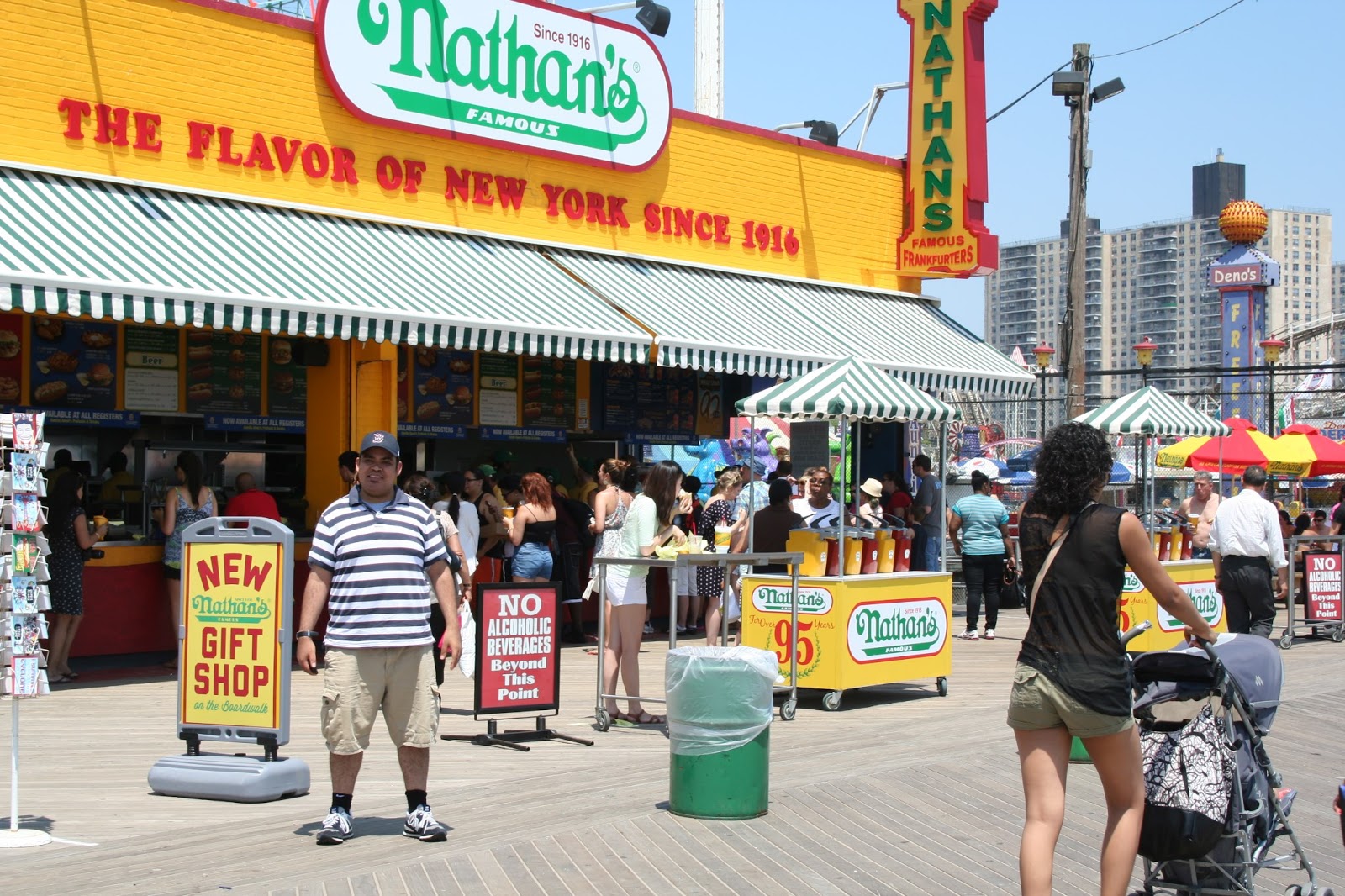
The next day we went to Coney Island, where the rides were shut, the effects of Hurricane Sandy were still evident but the board walk had lots of traffic.   I could hardly believe I was doing this stuff.
Thabie at Coney Island
                                                          
Then we went to the Botanical Gardens, my personal favorite place where, we borrowed a wheel chair and I tooled around, the energy supplied by Palesa.


Here I am tooling around the Botanical Gardens!


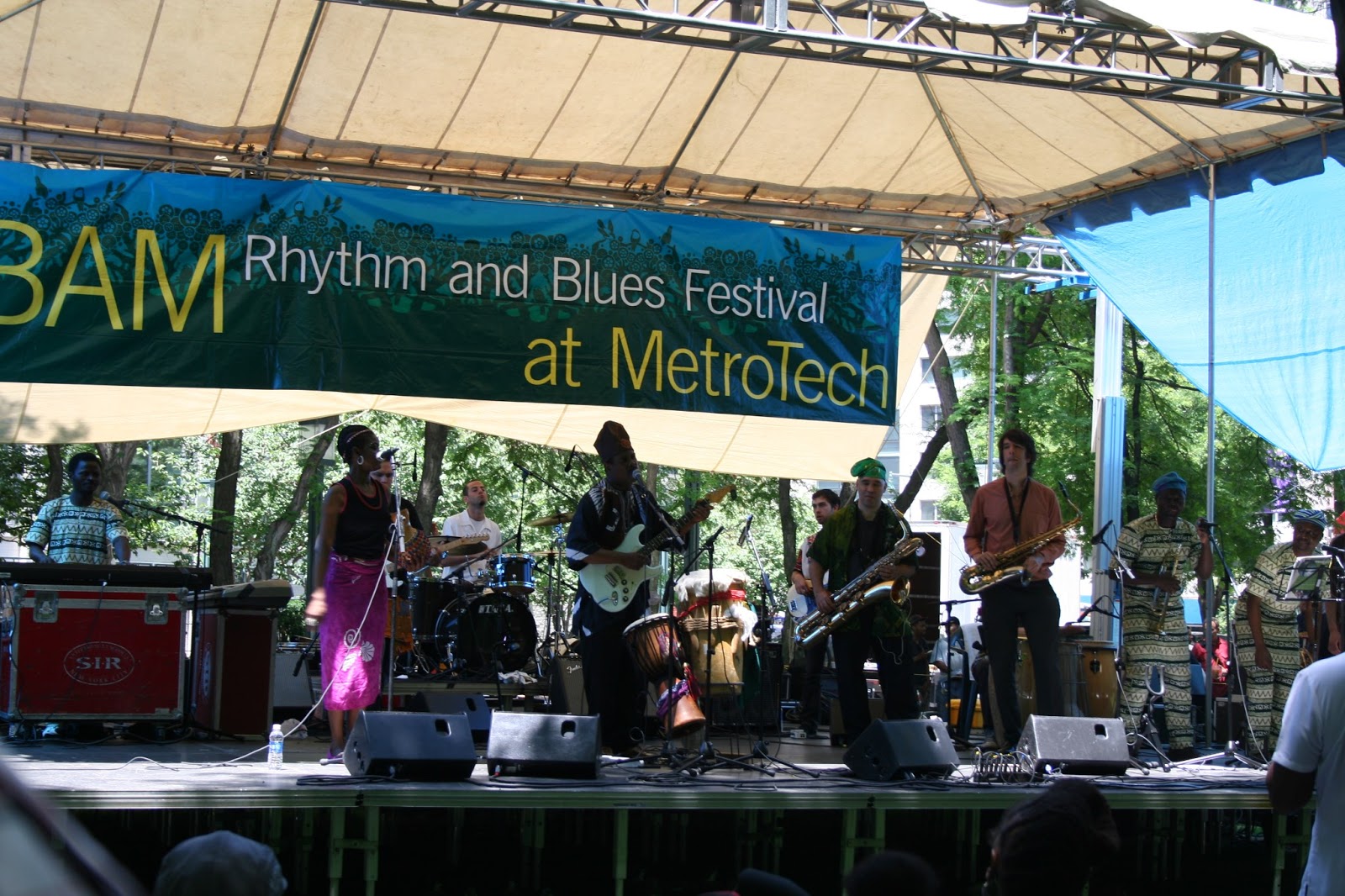
The next day we were off to the Brooklyn Museum, again on my own two feet, African art, ancient Egyptian stone carvings, Rembrandts, contemporary American art.   I had had a stereotypical notion of Brooklyn as a place of run down apartments and not much else.   Wrong!  Botanical gardens, parks, museums, and more.   Not the borough I had conceived of. On the next day we walked four or five blocks to an outdoor concert of African music near Metro Tech Center Commons where people were dancing and I struck up an acquaintance with Daryl from Harlem.


Music at the MetroTech Commons in Downtown Brooklyn


Here I am with Daryl


I realize that all this sounds like the tedious scribblings on travel post cards.   But the main point was that I was actually doing it.   A week earlier I would have said that all this was the stuff of dreams, nothing I could actually do.  The lesson for me was that I could do a lot more than I thought I could, thanks to the encouragement of Qenehelo, Thabie, and Palesa.  I  feel so much better for having gotten out of my chair, gone to Brooklyn and acted like any tourist!

Sunday, May 26, 2013

Octogenerians Rejoice

Friday's Washington Post (May 24) included the usual sadly depressing litany of people killing one another:  the page 8 world news digest included " 5-day death toll at 16 after frightful night" (Lebanon);  Rickshaw bomb killed 13 in Baluchistan"; "7 Iraqi soldiers shot dead at checkpoint." 

Then at the end a short note on an astonishing event: "Japanese man, 80, becomes oldest to scale Everest."   The paragraph notes that "an 80-year old Japanese man who began the year with his fourth heart operation became the oldest conqueror of Mount Everest. . . even with an 81 year-old Nepalese climber not far behind him."

This is the mountain that for the first half of the twentieth century the world's greatest climbers, in the prime of their lives failed to conquer, until Edmond Hillary and Tensing achieved the feat in 1953.   And they were young and in top shape.  Many octogenarians, myself included, consider it a challenging climb to walk upstairs in our houses and here are two men in their 80's, one of whom had recently had his fourth heart operation, on top of Everest!   It's almost impossible  to believe.

Mountain climbing has long been one of my favourite activities.  I've hiked the Green Mountains in Vermont, the White Mountains in New Hampshire (including several winter ascents of Mounts Washington, Adams and Lafayette, with some of the world's worst weather), The Rocky Mountains, the French Alps, and even  the Himalayan foothills.   But never have I aspired to try the great Himalayan Peaks. 

So I have no envy of Yuichiro Miura.  I have only incredulous awe of his feat and vast admiration.  At a time when I'm dealing with reduced physical capacities, he's climbing Everest after his fourth heart operation.  What a guy.  I'd love to shake his hand some day. 

Saturday, May 25, 2013

Young and Reckless in Nambia

You might think that after sampling a week behind bars in a Mexican jail, I wouldn't go near any more jails. Wrong!   (See my post of March 5).   During a school break when I was a Peace Corps Volunteer in Lesotho, a fellow teacher, Richard, and I decided to visit Namibia, which was then called Southwest Africa and controlled by apartheid South Africa.   How does one get from Lesotho to Southwest Africa without a car?  Hitchhiking, naturally.

Using this method we crossed the subcontinent and arrived in Southwest Africa, well south of Windhoek, the capital.   Our destination was Etosha Nationals Park in the extreme north, bordering on Angola.   Where would we, on volunteer budgets, stay during the nights?  Richard had read somewhere that if you went to the local jail and they had a free cell, you could bunk down there.   One problem solved.  We spent several nights in unlocked cells, not the Ritz, but a roof over our heads. .The other problem was that there was a war going on between the South African army and the freedom fighters of SWAPO (Southwest Africa Peoples Organization).  Well, we'd just have to be careful.  The jail idea having actually worked well, in due time we arrived in Windhoek.

In Windhoek we learned that all speed limits were off to the north to give motorists the chance to evade the war.  We rented a car in the capital and started off.   We encountered South African army patrols going through the woods and figured that all would be well once we got to Etosha.  So we had a pleasant few days watching the big game, confident we didn't need to worry about civil war.   There were no other visitors. Only later did we learn that SWAPO was using Etosha as its headquarters.

We made it back south where Richard and I parted, he going to Cape Town and I going back to Maseru, Lesotho.  When I arrived in Bloemfontein, the bastion of apartheid, it was evening and I had in my pocket enough money only for dinner or a hotel.  I opted to eat and afterwards made my way to local jail, where I was asked to wait for half an hour.  

Eventually someone showed up and said "I'll show you to your quarters."   I thought that sounded promising until I was put in a cell and the door was looked.   They had never locked the doors in Namibia.  "Wait!   I'm not a criminal!"  "It's for your own safety.  You'll be released in the morning."  Around 11 p.m.  the door was unlocked and a wildly drunk man, yelling and thrashing about, was pushed into the cell with me.   I immediately set about trying to calm him down with minimal success.  I may have slept an hour or two.

Sure enough, the guard opened the door at 6:30 a.m., where there was woman from the Salvation Army, handing out religious tracts.   "God bless you, my son," she said to me.

Later, when I was a Foreign Service officer in Lesotho, I told this story to the king who roared with laughter at my naiveté in thinking I could mosey into a jail in Bloemfontein without consequence.

Friday, April 19, 2013

Around the World in Thirty Days


I realize there are climate-change deniers, evolution deniers,and  birthers, but I doubt there are too many flat-earthers.   Undaunted I decided to check out the theory by circumnavigating the globe in thirty days.   As you will see this was a very bad idea.

It happened on my second annual visit to South Asia, as Country Affairs Officer.  I flew first to Pakistan, where I went to four cities where the US Information Agency had posts: Islamabad, Peshawar, Lahore, and Karachi.  I learned at a Peshawar diplomatic reception that cabinet ministers, when asked by the bartender what they would like to drink, would reply "oh, something refreshing," meaning something alcoholic.   In Lahore, at a minister's house, the host got out scotch, vodka, gin and the like.  All this in an officially teetotaling country.

I next went to Katmandu in Nepal, where, contrary to what you would expect, the city was shrouded with smog (thanks to the profession of motorized and poorly maintained rickshaws spewing exhaust) and most people went around nursing respiratory infections.  The Public Affairs Officer took me on a long drive into the countryside so that I could actually see the Himalayas.   Then on to Dhaka, where business men walked around the city in boots because of the mud and flooding.

Here's where it got interesting.  I theorized that if I was in Dhaka, it made no difference whether I went east or west on my way home. ,   Why not go east, visit Hawaii for a couple of days and then on home?  To justify my visit to Hawaii, I arranged for consultations at the East-West Institute, a cooperative academic venture.

My first stop was Bangkok, where I visited a friend who was Public Affairs Officer.  I had dinner at his house and asked to go to the airport hotel where I had a room.  My friend said there was no point in going until later at night because the traffic gridlock was overwhelming.   So we walked around visiting functioning crematoriums and I didn't get to me room until midnight.

Boarding for my plane was 2 p.m. giving me a mere two hours sleep before setting off on my foolhardy adventure.  We flew several hours to Narita Airport, outside Tokyo, where I had a seven hour layover.    The plastic seats were scientifically designed to prevent rest and the international boarding area was devoid of distractions.

Finally, still with only two hours' sleep,  I took off for Hawaii.   On the way, we crossed the international date line, putting the finishing touches on my disorientation and exhaustion.   Was it Tuesday or Wednesday, morning or evening?   I had no idea.   When we arrived in Honolulu,  I checked into my hotel headed for the bed, but no.   Mt hosts informed me that they had scheduled wall-to-wall appointments at the East-West Institute.   So I sat through scholarly discussions of oil pipelines through South Asia and similarly soporific topics.

I actually wandered off to Waikiki Beach where I utterly failed to appreciate its beauty.  Ultimately I was off to Detroit and finally back to Washington, arriving in total exhaustion.  The smart thing to do would have been to accept that the earth is spherical.   There's no need, believe me, actually to check it out.

Sunday, April 7, 2013

How to Stop Some Wars

As you look around the world, do you notice how many conflicts are based on religious or ethnic differences?  In Iraq, especially, and throughout the Middle East, we see the Sunni and Shia factions of Islam killing each other.  There are the Hindus and Muslims fueling the India-Pakistan conflict over Kashmir, the Israelis and the Palestinians so wary of each other that they seem unwilling to negotiate.  We have the Hutus and Tutsis in central Africa, the Africans, Indians, and whites in South Africa.

And so it goes.   We tend to lump people together into groups and say, in effect, I don't need to know those people individually and personally because I know what people in that group are like.  But that's just what we do need to know.

My focus today is the little known, small island of Cyprus, in the news recently because of its precarious finances.  Reading the stories you'd think the Greek-oriented government was the government of all Cyprus.  In fact  since 1974, Cyprus has been a divided island with the Greek-Cypriots controlling the southern two thirds and the northern portion controlled by the Turkish Republic of Northern Cyprus, protected by 30,000 Turkish troops.  There is a border between the two which is difficult to cross.

When I retired from the Foreign Service I had the good luck to get a job with AMIDEAST, a non-profit promoting educational exchanges.  I was assigned to the Cyprus-America Scholarship Program.   We monitored academic progress and visited several students twice annually.   But an important aspect of our program was promoting understanding between the two sides.   When I started on the program we had Greek- and Turkish-Cypriots on the same campus who didn't bother to talk to each other.

As a result we organized week-long conflict resolution workshops held at Coolfont resort in West Virginia.   The students lived in cabins in the woods and spent their time in a series of role-playing exercises run by the Conflict Management Group of Cambridge, Mass.   One game I recall: groups of Turkish Cypriots were asked the imagine they were Greek Cypriots, and a group of Greek Cypriots
were told to pretend they were Greek Cypriots.  Then the "Greek Cypriots"(actually Turkish Cypriots)  were asked to say what they thought of Turkish Cypriots and the reverse.  It was a way of seeing the others' point of view.

After classes the students socialized as one homogenous group, taking meals and playing sports and outdoor games together.   They formed a circle with a blindfolded student in the center.   He leaned back untl he started to fall, but was caught by other students.   He had trusted them.  then there were the high ropes with trip wires.   Below are two pictures of the students talking and listening to each other.


After a week together, the students were hugging each other and singing together.  The camaraderie continued back on the campuses where if a student got sick, he/she was sure to be visited by both Greek- and Turkish- Cypriot friends.  What the students had learned was that whatever cultural, ethnic or religious differences exist between people, their common humanity draws them together.  Before all, we are just people, wanting to make something of our lives, needing to be loved.


Monday, April 1, 2013

Adventures in Pakistan


After fourteen years in Africa, I returned to Washington where eventually I became Country Affairs Officer to South Asia, responsible for Afghanistan, Pakistan, Nepal, and Bangladish.   I supported and oversaw USIA activities in these countries and, once a year, I visited to check out their programs and meet relevant government officials.

Reading the newspapers these days, you might well conclude you didn't want to go to Pakistan what with suicide bombings and sporadic attacks by the Taliban.  My first visit to Pakistan was in 1993 when things were less volatile, but not without adventure.  When I arrived in Islamabad I checked in at the Holiday Inn, a familiar and comforting presence.  Around 5 p.m. a delicious looking spread was laid out in the lobby and where I, a vegetarian, tucked into the fresh salad makings.

A bad mistake.   In a few hours I came down with a major case of gastro-intestinal infection.   The next day wall to wall meetings with ministers and the like lay before me like an obstacle course.  The challenge was to try to focus on substantive issues all the while wondering if I could make it through an hour without needing the rest room!

I next went with some USIA officers to Peshawar close to the lawless west and various warlords.  I checked in at the Continental Hotel (since blown up by terrorists) where a large sign in the lobby read, "Gunmen!   Please check your weapons at the front desk."  What?   There were gunmen staying at the hotel?  I had noticed driving through town that almost everybody was carrying a weapon and recalled a US Consulate officer intoning that an armed society is a civil society.


After the usual round of meetings with Pakistani officials,l my hosts decided a trip to Khyber Pass would give me an idea of the section of the country not controlled by the central government.   Khyber Pass was officially closed but a special exception was made for the visiting Washington official.   The government assigned a soldier with a rifle and a sash of bullets, ostensibly for my protection, but possibly to keep an eye on me.   We drove up a long, narrow winding road past the fortresses of warlords to the top of the pass overlooking Afghanistan, which was definitely closed to us.   Large trucks, probably loaded with contraband, seemed to be crossing the border into Pakistan virtually uninspected.   As a momentum of the occasion, I was photographed with my protector.  Afghanistan is in the background.


In the picture directly above, he has handed me his rifle, presumably to impress my friends.  

The next item on my getting-to-know-Pakistan tour was a trip to a village, rural certainly, but the home of a rich man.  A nice outdoor lunch was spread out and we ate peacefully with our hosts.   But not for long.   The after-lunch entertainment was. . .shooting off machine guns at the sky to wild yelling and cheering..   I hate to think of where the bullets came down.

Finally I arrived in Karachi, a violence plagued city.   I checked into an international hotel and thought what I really wanted was a cold beer.   I called room service and in due time a man showed up with a bottle of beer, a chilled mug, and a bag of potato chips.   First he had to inspect my passport to be sure I wasn't a Pakistani in this officially teetotalling country.   Next I had to sign an affidavit:"I certify that this beverage is for bone-fide medical purposes only."   But of course.   Welcome to Pakistan!


Sunday, March 24, 2013

Village Life in Lesotho


As I venture on this topic, I'm keenly aware there are experts in Lesotho - Kaybee, Lineo, Lipalesa, and Sebitsa - my nieces and nephew, who know far more than I ever will and who may be reading my blog.  So, let's rephrase: these are the observations of someone who grew up in a suburb of Boston on the beauty of Lesotho's rural life.

We have gotten into the habit of dividing the world into developed and developing nations, implying that becoming developed is the goal of developing nations.  But this was not my impression after living in Lesotho, my second home, for nine years.


My wife, Qenehelo, grew up in the small village of Tsoe'ng.  As a young girl, she fetched water by walking a fair distance downhill to a spring, filling a large bucket with water, and carrying it back on her head.  During dry seasons she had to get to the spring before dawn because the spring dried up early.   She fetched cow dung from the fields and brush from the mountain for cooking.  So meals were cooked outdoors and water had to be used economically.


Most of the dwellings were mud huts (rondavels) with thatched roofs.    Qenehelo's family had a round house for cooking and a rectangular house for sleeping. There was no electricity.  At the top of a hill was a large building (mud walls and corrugated iron roof) which served as a school room during the week, a church on Sunday mornings, and a concert hall on Sunday afternoons.


Outside the houses chickens clucked about and in the kraals cows, sheep, and pigs mulled around.


Because the houses were small, people left their doors open all day and visiting neighbors was the main way of spending the day.   The contrast with my current neighborhood, where we speak pleasantries across the street and close our doors is striking.  Qenehelo's mother, 'Matiisetso, one of the kindest, most generous people I have known, was a wonderful example of neighborliness.   When she was cooking, village people might loiter about the door.  'Matiisetso would always bring them a plate of food.  Once a neighbor came saying she has no money for her daughter's school uniform; 'Matiiesetso without hesitation went to her teapot where she saved money for sugar, tea, and the like, and handed all her money to her neighbor.


At risk of over romanticizing, the village seemed like a family of two hundred people.  At weddings of village girls, everybody joined in the procession to share the joy; at funerals the whole village joined a procession to the church and then to the burial site to honor the person's life and to see he or she was buried with dignity.   After the funeral, everybody went to the home of the deceased, first to wash their hands (removing death), and then to join in a feast.

Even the names by which others are addressed reflect the sense of family: a woman is called "'Mme" (mother), a man is called "Ntate" (father), a girl is addressed as "ausi" (sister) and a boy a "abuti" (brother).   These names are for everybody, not just members of one's family.

I don't want to imply that there wasn't both good and evil in Lesotho.   There was.   But the societal norms favored sharing, neighborliness, and a sense of community.  The heart and soul of life in Lesotho lay in the villages, where most people live, where neighbors look after neighbors.